Thursday, May 13, 2010

A Quick Stopover in Taipei

A few weeks ago I made a short stopover in Taipei, Taiwan on my way back to Thailand for a quick visit and to say hi to a couple I know who work on the island.
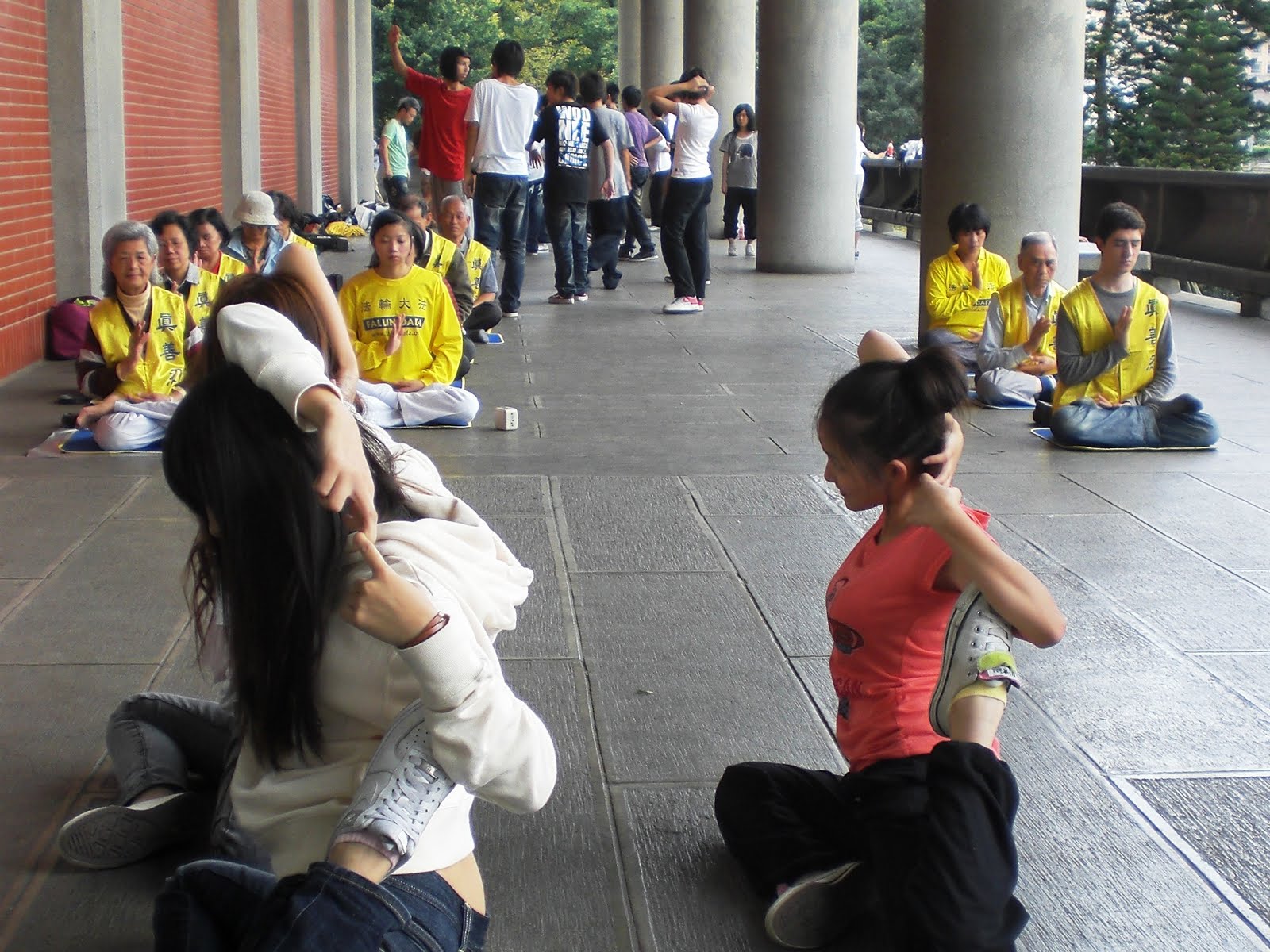
Besides a few of the temples, public spaces and parks, the aesthetic of the city - crowded, with functional architecture and drab, if any, decor - is not too exciting. So on a Sunday when most people take a day off their hectic and packed East Asian schedules, the spaces around museums and parks make for some absorbing people-watching. It seems that everyone who can be out, is out. Around several of the places we visited, packs of teenagers practiced their dance moves and competed for space with the yellow shirt Falun Gong (or Dafa) followers meditating. The photo above shows teenage girls staking out there spot next to Falun Gong followers, who were making their cause known especially to Chinese mainlanders visiting tourist hotpots. Today, May 13, is the "World Falun Dafa Day" set aside for the religious movement to commemorate the spreading of the message to the public. Below are a few more photos from the trip.

Tuesday, March 30, 2010

A Weekend with the Venerable Dhammananda

The Venerable Dhammananda is charismatic, warm, well-spoken and leaves a strong impression on those who've met her - and has the distinction of being the first Theravada bhikkhuni (female monk) in Thailand. A few weeks ago I went down to Nakhon Patom to spend time at her center at Wat Songdhammakalyani. As it was a slightly more stressful time than usual, this weekend retreat was perfect timing. I went with Brooke Schedneck, a friend from Harvard Divinity School days who is in Thailand doing field research for her dissertation (both of us pupils of our beloved Don Swearer). Brooke is interested in Ven. Dhammananda as a meditation teacher to foreigners. I am interested in Ven. Dhammananda's thoughts on on gender and inter-religious dialogue. I probably would not have made it a weekend-long venture, but Brooke has done so many meditation retreats she made it easier for me to deal with the simple monastic life of hard beds and waking up before dawn.

I first met and interviewed Ven. Dhammananda in 2007 at the International Conference on Religion and Culture in Chiang Mai where I presented a paper on Buddhist art and gender. In our first conversation we discussed gender in the writings of Dr. Chatsumarn Kabilsingh for several minutes before I (finally! gasp ...) realized Dhammananda was Dr. Kabilsingh before her monastic metamorphosis! Same person, different name. This slightly embarrassing episode served our discussion well. As we both noted, my momentary non-recognition reinforced a point we were making: ordination visually removes the easy markers of gender - a face without make-up, shaved hair, robes concealing sexed contours. Dr. Kabilsingh was for over 30 years a professor of philosophy and religion at Thammasat University, where she wrote the bulk of her many works on, among other things, Buddhist texts, commentary, and gender. But her commitment to monastic life can be seen anchored even further back than academia, to her extraordinary childhood as daughter of Ven. Voramai Kabilsingh, the first Thai bhikkhuni, ordained in the Taiwanese Mahayana line. Her life was saturated with chanting and meditation. Her mother converted their home into Wat Songdhammakalyani (literally, the temple of women who uphold the dhamma). As a young girl she says she could recite whole chants by rote memory "like a parrot." Life as an academic allowed her to explore the meaning of what she memorized as a child. She told us she waited until her youngest child passed 25 years of age before she followed her mother's footsteps and ordained. But going further than her groundbreaking mother, she sought a Theravada ordination through the newly revived bhikkhuni tradition in Sri Lanka. A proper Theravada ordination would give her a greater chance of recognition in the Thai Sangha (the official ruling hierarchy of Thai Buddhism), and would better situate her to pass on the bhikkhuni lineage at home.

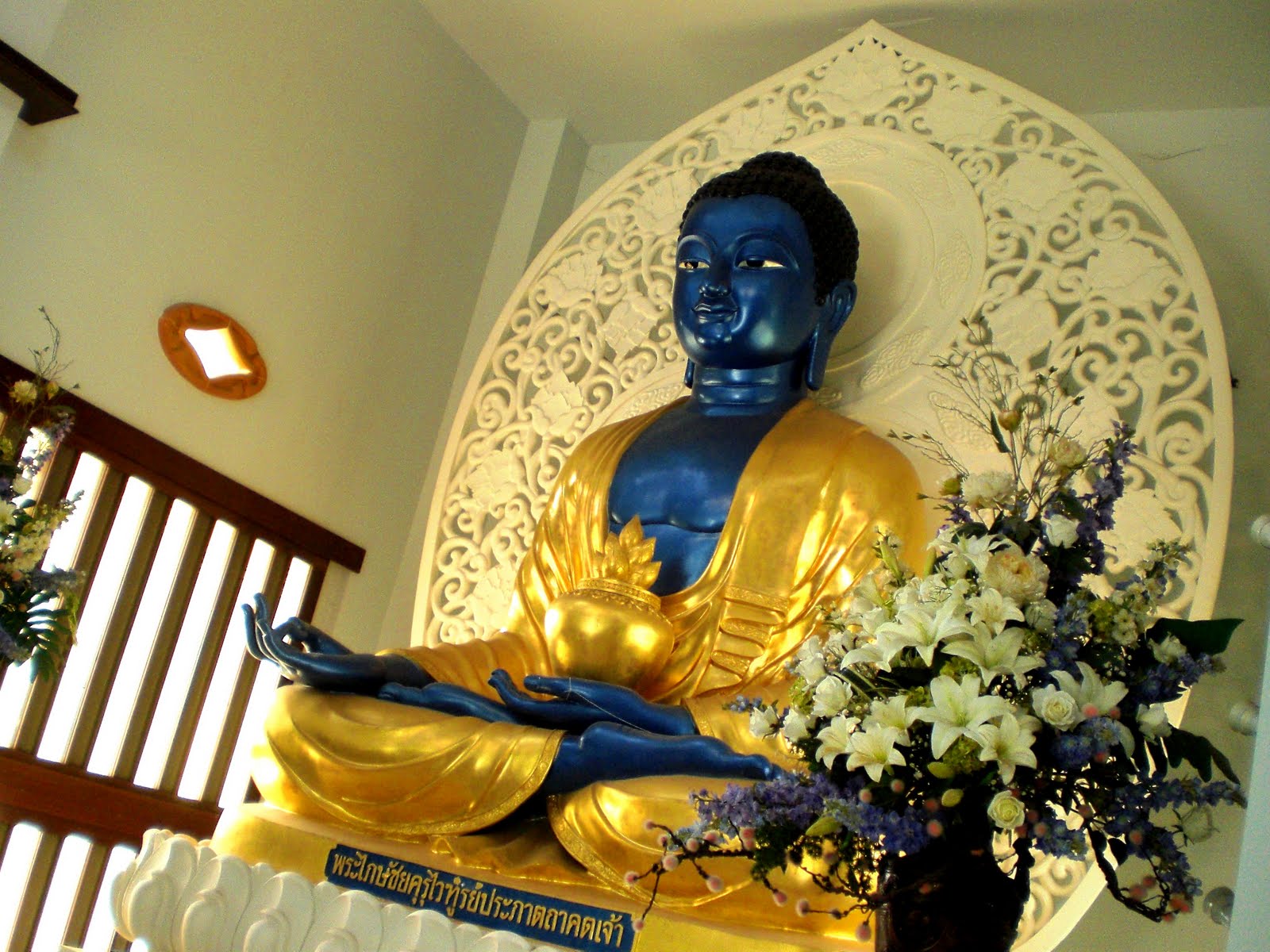
Brooke and I arrived and quickly got into the rhythm of the weekend events. We were plopped in the middle of a training session for the center's core volunteers. On the whole they were nice and helpful - presumably that is part of the training! as they prepared to take some of the workload off Ven. Dhammananda and the other samaneri (female novices). We skipped the sessions on temple rules, taking care of guests, and how to give tours of the grounds - I for one needed rest and was desperate for a shower (the first of three that day) after an overnight bus and the inferno-like heat of Nakhon Patom at noon in the height of hot season. One interesting session was on Visualization. Put in simple terms: how you 'visualize' an object or problem can determine your response and approach to it. A bit of experiential learning helped to demonstrate the point. Four of us were asked to visualize a volunteer sitting in a chair as a heavy stone. When it came time to lift the woman from the chair with our fingers, we couldn't make it happen. But when we closed ours eyes and visualized the woman as a feather, we lifted her up easily. It worked! The use of Visualization meditation and mental training exemplifies the many ways Ven. Dhammananda draws from Tibetan Buddhism. More importantly she draws from the Tibetan tradition her own understanding of the Medicine Buddha. Ven. Dhammananda has a local reputation as a healer and had a distinctive vision of the Medicine Buddha fleshed in blue (top photo).

We were encouraged to join the morning alms rounds. I wasn't sure what to expect, or if that many people would give food to female monks, but they are known and taken care of by the nearby villagers. They also know she is a strict vegetarian, thank goodness, because I didn't want to feel obliged to eat seafood or something worse at 7am. The samaneri giving the blessing is adorable (top-right), she loves to touch and talk to the alms-givers. Of course in good Thai-time some lay people rushed up on motorbikes moments before we entered the gates. That seems also routine. Bottled water, blessed by Ven. Dhammananda, with the blue Medicine Buddha logo (left), are distributed to alms-givers in need of healing.

We were joined later by a documentary film maker from The Buddhist Channel in France. The three of us went everywhere Dhammananda went, which was great. She received an invitation to the chanting / fund-raising event by the abbot of Wat Luang Por Sot, an unfinished but huge Dhammakaya temple nearby. The abbot supports Dhammananda and the revival of the bhikkhuni line in Thailand, but he is limited by the constraints placed on him by the Thai Sangha. He showed his support by inviting her to present gifts to the male monks at the ceremony. Of course it wouldn't be a Dhammakaya event without attracting the rich and famous, so there were a few Thai movie stars giving gifts as well! Ven. Dhammananda sits in a special place (left). We were behind her with the mae chii (nuns who dress in white, shave their hair and follow 8 precepts) and other female laity dressed in white, and we were escorted to the 'VIP' section for lunch.

Ven. Dhammananda interprets the Thai Sangha's refusal to recognize the new bhikkhuni lineage as mixed. The lack of legitimation by the national hierarchy leaves a great deal of room for intellectual freedom as a public figure and autonomy to make decisions without having to answer to the Thai leadership. Last year, 30 women joined in a 9 day temporary ordination. They expect at least 50 this year, while busy figuring out how to house them all and constructing a new building for future growth.

It is no wonder that Ven. Dhammananda has become an important Buddhist voice. Her belief in her gender equality, dialogue with Buddhist and other faith traditions, inviting presence, command of English, and reputation as a healer, attract seekers and scholars alike. It was a much needed retreat for me, and to paraphrase a popular saying from one of her books, a calming of my monkey mind.

Monday, December 21, 2009

Merry Christmas, Happy New Year 2009

I want to wish everyone a joyous holiday season!

I'm thankful for a lovely year once again for work, play and travel.

This season I will be spending the holidays staying close to Chiang Mai, quite busy with deadlines, yet still able to join in the many fun celebrations with friends, colleagues and students.

I will be missing my family quite a bit this Christmas. But people have really shared the Christmas giving spirit. I want to Thank Joan Eubank in particular for the cute little handmade wise-men from a Wa minority village. They look great around the tree.

Merry Christmas and Happy New Year.

Saturday, October 31, 2009

Wedding in Danang, Vietnam

A wedding was the occasion of my third trip to Vietnam. My first trip was to Hanoi and the north, and second was to Saigon. Both times I met with some unpleasant encounters. But time, distance, and reassurance from friends who said they would watch out for me prepared me to go back again. This time was to the city of Danang in the central region.

October is rainy season, so it poured torrential rains to the point of major flooding. Our outings were somewhat limited, and two days of running around in half a foot of water gave me a nasty cold - which I passed on to my travel buddy, JLoh. We did get to visit the beach (above), with a white Quan Yin statue on the mountain. Mostly we hung out at coffee shops and ate scrumptious local dishes at fun restaurants. One place we got to enjoy great food was in the quaint town of Hoi Anh, where we ate at one of the oldest establishments in town. The cao lau noodles are particular to this area and the water has to be drawn from a special blessed well. Parts of Hoi Anh still maintains narrow, cobble stone streets where cars cannot threat, so as you can see in this picture, it was quite an adventure to get around in the rain!

As for the wedding....
Let me say that my observations are colored not only from me being an outsider, but as someone more than a little suspicious of the capitalist love story that is the wedding industry and the kind of gender cliches much of it plays into. But you can take what I say in a light, fun-loving manner, and in all honesty, I thoroughly enjoyed myself and am very happy to have joined and contributed to this celebration. But enough by way of prologue.

The wedding unfolded in three main events: an intimate morning blessing with breakfast and coffee, a larger church service mid-morning, and finally a huge reception over lunch. The groom is from a big Christian family, and the first part of the celebration was held at the girls orphanage his family runs.


About the reception - wow. The reception was held in one of the many huge event halls that line the riverfront. We were in a place called "Golden Palace," but I secretly hoped it would be at the "4U Palace" next door, just to say I went to a place with that name. There were at least three other wedding receptions occurring in the other halls, and several more evening weddings the same day. I'm still trying to figure out how so many people in Vietnam are getting married; if tying the knot is in decline in Europe and North America, it is as robust as ever in Vietnam! With all the weddings going on at the same time, it's easy to imagine that people might sometimes walk into the wrong hall, and worse, put their monetary gifts in the wrong basket. A misfortune, I'm told, is not uncommon! We knew it was our friends' wedding because there were huge photos of the couple at the entrance. JLoh and I got a kick out of these because some were the most hilariously contrived poses we'd ever seen. I'm not talking about the typical western white wedding dress-tux photo, or the Thai bride in Vietnamese garb. I'm talking about the bride serenading her man with a violin (knowing, for certain, it was the first time she'd ever touched that instrument!), or the groom riding a bicycle on the beach while the passenger bride held a bouquet to the sky as the flowers flowed in the wind. After perusing the photos, we made our way to the huge and nicely decorated hall for the 650 attendees.

To give a better feel for the events at this colorful reception, I will retell things as they happened. We immediately sit down to start our seven course lunch. Everything is absolutely delicious, and I tried everything, everything! Except for the cow-tongue. People are eating and talking when the MC comes up and begins announcing something in a very official, excited tone - of course I have no idea what he was saying, everything is in Vietnamese, and I'm one of exactly two non-Asians there.

Suddenly, a thunderous blast comes out from the speaker, there is smoke everywhere with flashing red lights, they play the opening music of Carmina Burana, and a mechanical catwalk comes out of the stage. Oh, the anticipation! Is this the bride and groom coming?! Not yet ... A young man and women make their way up the steps singing a love song. On the stage, three women and a man ballet-dance to the duet (below).

A little while later, after pyrotechnic and confetti explosions fly all over the stage, the bride and groom enter the hall. Their parents join on stage as well for greetings and thank you's. I shouldn't forget to mention the cake boys who usher in the five pieces of wedding cake, and stand guard as the newlyweds light candles and make the first cut. After the party leave the stage there are some minutes of eating and talking as the newlywed go around from one table to the next greetings guests. Then, in unison, people suddenly stand up to leave, and the father of the groom quickly takes the microphone to say a short goodbye, as people file out. The place was near empty in five minutes, except for our table, with JLoh and I still holding our chop sticks, confused about what to do next, and really, waiting for a piece of wedding cake. We came to discover that the cakes were fake. Disappointment! After a mini photo-shoot on the stage, we get ready to head back to our hotel and are quite surprised to hear the newlyweds announce: "be ready, we're coming to pick you up in about 2 hours, we're all going out." Their priority was taking care of their families and friends that came to the wedding, and they didn't even sleep in the same house until they left Danang three days after their wedding.

On our way back to Thailand we stopped in Ho Chi Minh City. It was a pleasant visit, and I owe that entirely to friends and former students, who accommodated us in the most hospitable and gracious way possible. It was so good to see many of them. Some are involved in all kinds of exciting projects and ministries like media, theological training schools, and working with Vietnamese migrant workers newly returned from labor exploitation in Malaysia. Outside of the safety of the city, some Christian groups struggle much more to launch ministries. In the central region of Vietnam, where "house churches" are not officially recognized by the government, Christians are periodically persecuted and oppressed. One of the bridesmaids had to leave right after the wedding to deal with the recent wave of harassment of Christian teenagers from her church. While we were discussing this, I was so touched by her perseverance, optimism, and faith that God would open the way. "Despite all of this, I feel so much joy." How remarkably inspiring! Many thanks to all the Vietnamese who made the trip for us.
Thursday, September 24, 2009

Fundraiser and Ordination for Cambodian Youth Summer Camp

This summer a few friends invited me to attend a monk ordination ceremony and fundraiser for young Cambodian monks. It was aimed at youth at risk or dropping out of school or who lack educational opportunities. It was held at the temple Wat Suan Dok through Cambodian students at Mahachulalonghorn Buddhist University. Mahachulalonghorn has many monks enrolled from Cambodia who are quite bright and active. Many were the same monks involved in our Buddhism and Christianity course based on inter-religious dialogue involving Christian and Buddhist students this semester.
In this fundraiser you could make a donation in two ways. One is the easy way: foreigners, non-Buddhist, and people in a hurry gave directly to the money box and kindly wrote their names, personal details, and organization to be read out loud later. A second way to give, which is more intricate, more aesthetic and more meritorious, is to shape bills into a lotus flower. Below left is a Thai bill in made into a flower; below right the communal process of opening the flowers.
A couple of my friends were so touched enough by the cause they went on to be ordained with these young monks in Cambodia. I was glad to have made some new friends among the monks - and many are part of internet social networks. Those connections became a good basis later for building trust and engaging in dialogue with Christian students. Left are some of the participants and observers after the ceremony. Thanks to all who invited me and the monks who remained connected after. Click play to listen to the ordination chant:


[Listening may require Quicktime plug-in and settings]

Monday, August 31, 2009

Buddhism and Christianity Course Coming Together

Not often do you see a group of Buddhist monks in church in Thailand, but that was the privilege of our Buddhist and Christianity course a few weeks ago (left). Christian students also had the chance to visit the temple at the end of the Buddhist Lent, accompanied by the same monks. This was all made possible through the Buddhism and Christianity course I am co-teaching with Rev. John Butt, this year with the help of intern Charlie Carstens from Harvard Divinity School. This is the second year I have been involved in the course, and it has been great fun. Each year has been different; last year John arranged for a guest once a week to speak from the Buddhist community. This year however, I was determined to get current and prospective Christian leaders from our program and monks together in the same classroom space. Thanks to meeting ajan Steve Epstein at Mahachulalonghorn University at Wat Suan Dok, we were able to make it happen. The result was six wonderful gatherings together. It was a learning experience for all of us.

Inter-religious dialogue can be difficult. We were careful to set the right tone, to have comparable goals without forcing conformity, to pose the right questions, to moderate discussions well while encouraging student interaction. In one session, for instance, we discussed how 'GOD' and 'DHAMMA' (or DHARMA) might be two ways of talking about ultimate transcendent truth and reality, but withheld making any definite assertions about whether they refer to the same reality. We also had to, for example, agree that engaging in inter-religious dialogue is desirable and worthy in itself, and not simply a subordinated means to another goal - whether that goal is convincing someone to put on a saffron robe, or just to learn useful facts about another religion ... All this really takes practice, as we came to find out very quickly that the Christian students had very little experience talking about their faith outside the circles of their tradition. As a first time venture for many, I think our dialogue went quite well.
There were perhaps some apprehensions at the onset about a hidden agenda to proselytize the other, especially since the monks sometimes have evangelical Christians who come to their tri-weekly monk chats expressly to 'save their souls.' Yet in the end, there was perhaps at least the seeds of conversion, if conversion is expanded to mean not simply changing one's faith tradition, but being open to transformation through the sharing of faith - and allowing one's faith to be challenged and even changed in conversation with others. All in all we had representatives from the Americas and all over south east Asia: Cambodia (where most of monks were from), Laos, Burma, Vietnam, and of course Thailand from Jewish, Christian, and Buddhist traditions. Thanks for all for such a warm experience.