The Changing Contours of World Mission and Christianity: Salvation in the African context: Editor’s note: The following post arises from small group reflections from The Rise of Global Christianity, 1910–2010, taught by Dr. Todd Johnson at Boston University in the Fall of 2010. Led by doctoral students, the small groups discussed lectures given by Christian scholars in various disciplines, including significant changes that have occurred in global Christianity over the past 100 years.
The guest lecture for Global Christianity this week was Dr. NimiWariboko, who gave a general overview of African cultural and religious framework, and went on to discuss independent church movements in Africa and how they positively contextualize the gospel – resulting in high church growth. Two broad movements among independents are Pentecostal – Charismatic churches, and African Initiated Churches or African Independent Churches (AICs). In their own ways, both preach a message of concrete blessing, transformation and salvation for people in this lifetime. The focus on material blessing is sometimes called ‘prosperity gospel,’ a phrase almost exclusively used by those who find it in some way suspect. Our discussions centered on how to understand and evaluate a concept of salvation that emphasizes the present in African context.
We found Dr. Wariboko’s lecture very helpful since he put the preaching of so-called ‘prosperity gospel’ within the preview of an African framework. On one level, religion pervades all of life. Meaning, religion in Africa is neither isolated nor compartmentalized chronologically – postponing salvation into the future or afterlife. Neither can it be put in a separate ‘private’ sphere or emotion. Religion in general and Christianity by extension permeates the whole life of the believer, very much inclusive of physical and material existence. In this way, the Koreans in our discussion noted, a view of religion as integrated into all parts of life might not be so different than some Korean churches, particularly Full Gospel churches that are within the global family of the Pentecostal - Charismatic movement.
On another level, a ‘prosperity gospel’ represents hope that God can transform lives and liberate people in the here-and-now. This hope is an important message for people in deep economic, social, and even physical turmoil, as many people might struggle with poverty, disease, and the reality and consequences of war. We found an understanding of salvation that is holistic often rings true. It is especially attractive as African Christians also may focus on transformation of all the earth, humanity, animal life, and the restoration of all of nature.
The Changing Contours of World Mission and Christianity: Protestant-led ecumenical movements: Editor’s note: The following post arises from small group reflections from The Rise of Global Christianity, 1910–2010, taught by Dr. Todd Johnson at Boston University in the Fall of 2010. Lead by doctoral students, the small groups discussed lectures given by Christian scholars in various disciplines, including significant changes that have occurred in global Christianity over the past 100 years.
Our discussion this week centered on Protestantism over the last hundred years within the broader context of Global Christianity. The term ‘Protestant’ includes churches within what are often referred to as ‘mainline’ denominations. These churches have roots in the Reformation (including Lutheran, Reformed, Presbyterian, Methodist, and Congregationalist). Within Protestantism two important tensions surfaced: denominational division (both between mainline traditions and internal break-offs within a tradition), and the ecumenical movements of the past century initiated between Protestant churches. It became evident in our discussion that these tensions can be viewed as challenges or opportunities for renewal.
Historically the ecumenical movement began with Protestant churches as much for practical reasons as for theological commitment to Christian unity. The extensive complexity denominational divisions present head-scratching challenges for missions when several denominations ‘compete’ to present the gospel. It also threatens the long-term sustainability of small congregations of Protestant Christians coexisting in proximity but administered under different denominations. Ecumenical cooperation has the advantage of presenting a united front of Christian unity. It worked well in regions with small Christians populations where no one denomination dominates, such as North India and Thailand, where various churches pooled resources and united.
In our discussion group, however, few knew about Protestant led ecumenical movements, and few experienced an ecumenical spirit within their churches. Dong Gyun expressed that in his Korean Presbyterian heritage there are many internal struggles and many break-offs. Maintaining a distinct identity overshadows the desire for unity. Jin, who is also Korean but a Methodist, pointed out that his tradition remained united in Korea, and much emphasis is placed on staying together within that church, and not so much on communion with other Protestant denominations. The ecumenical spirit was so far removed from Jeff’s local congregation that he questioned whether Protestantism should be distinguished as a group for their ecumenical efforts.
The gulf between the lack of ecumenical awareness and engagement on a local level, and the reality of the ecumenical councils within Protestant churches may be explained by the fact that ecumenical movements seem to have taken place among higher levels of church leadership, far away from the pews. In the book Boundless Faith, Robert Wuthnow draws attention to the centrality of the local congregation rather than the commitment to denomination administration in the lives of American churchgoers. Dong Gyun felt that was right in many ways for it seemed to him that local pastors have a huge influence on whether or not a given congregation will engage in ecumenism. We were left with the important question of whether ecumenism could be more powerful if engaged from the ‘ground-up’ – from the local worshippers to the denominational leadership – and what consequences that might have for Protestants.
Editor’s note: The following post arises from small group reflections from The Rise of Global Christianity, 1910–2010, taught by Dr. Todd Johnson at Boston University in the Fall of 2010. Lead by doctoral students, the small groups discussed lectures given by Christian scholars in various disciplines, including significant changes that have occurred in global Christianity over the past 100 years.
Our discussion in Global Christianity this week was launched from Dr. Todd Johnson’s presentation centered on the resurgence of Christianity in the global South. As Christians become more represented in the Global South – a trend that moves to better represent the distribution of the world’s population – two high growth areas of Christianity caught our attention. One is the growth of what The Atlas of Global Christianity terms “Marginal” Christians, a category that includes such organizations as Jehovah’s Witnesses and Mormons. Jin and Jeff questioned whether they be called Christian at all, even if the term ‘marginal’ serves as a qualifier. Although it is not an ideal term, it does capture the viewpoint that many more ‘traditional’ Christians hold. Jeff added to this standpoint: “It seems to me that Mormons are about as Christian as Muslims are Christian. Both have respect for Christ, but both insist that further prophetic revelation was necessary.”
The second area of Christian growth that caught our attention was Africa. Africa is the continent that has experienced the most significant growth in the Global South, particularly within the independent African Initiated Churches (AIC’s). Jin was quick to ask us what we think of the character of the African churches. To Jin, it seems that many African churches, especially AIC’s are a little different; aside from dealing with social concerns such as HIV/AIDS, they seem more interested in spiritual power and healing, and prefer more charismatic liturgy than in any other region of the world. It does seem that although they may have their own flavor, the message they preach, for example in spiritual healing, is inspired by accounts of such healings and exorcisms found in the New Testament. “I don't see a problem with the way they are exercising societal Christian practice,” Jeff suggested. “It seems in keeping with Christian history and tradition.” If the language African churches use follows the Bible and is Christ centered, what is it about some African Churches that might sound illegitimate? Can we identify what is behind our discomfort?
It does seem that the African context is rich in animistic traditions, and when Christianity moves in, it has to adapt to local cosmology. One question to ask is whether we can accept that some Christians believe in demons and spirits? Or should all Christians adopt a “western” cosmology? As Dong Gyun commented: “compared to the West, which is more rational and fond of systemization, Africans may have a cosmology that is more attuned to spirits and demons that others may see as unchristian.” He went on to draw from his experience: “Once you become a Christian in Korea, you cannot invoke spirits or pay heed to those practices of the past … There isn't any mixing of folk religion.”
I asked everyone what they would do if a woman came up to them convinced they were plagued by harmful spirits. Interestingly, despite all our reservations, not one of us thought that asking her to stop believing in her experiences would help her achieve spiritual wholeness. Jin shared that a similar episode happened to him. “It's a bit hard for me to discuss it, because when I share it, many people think I am weird. But as it is mentioned in the Bible, there are demons. I would like to do what Jesus did, and help her get rid of what is plaguing her.” I also shared that if I had been presented with this scene three years ago, I would have reacted by wanting to reconstruct the woman’s worldview. However, today I would be more open to meeting her somewhere closer to her own belief system.
Is that not, then, a strength of Christianity, and of the African churches that emphasize healing, to meet Africans where they are? Perhaps that is why in the last few decades Africans have been so successful at presenting the good news to other Africans because they can meet them where they are and bring about a sense of spiritual wholeness.
Editor's note: The following post arises from small group reflections from The Rise of Global Christianity, 1910–2010, taught by Dr. Todd Johnson
at Boston University in the Fall of 2010. Lead by doctoral students, the small groups discussed lectures given by Christian scholars in various disciplines, including significant changes that have occurred in global Christianity over the past 100 years.
In our Global Christianity course this week we were fortunate to have a guest lecturer, Dr. Brian Grim, who spoke on the measurement of religious freedom in countries across the globe. Dr. Grim showed rankings in terms of social attitudes and government restrictions that pertain to religious freedom, broadly understood. Some of the countries that ranked in both extremes, high and low, were surprising to some of us. There are two South Korean master’s students in our discussion group. One student, Jin, was both interested and shocked that South Korea did not get a more severe rating. Although South Korea constitutionally guarantees freedom of religion, some of the Christians he knows experience some social pressures. Furthermore, Jin said that it was difficult to negotiate his pacifist beliefs with mandatory military service. Another South Korean, Dong Gyun, noted that there are many subtleties to religious freedom to consider. In our discussion we noted that although minorities may experience significant degrees of social pressurefrom family or friends, such as in South Korea where Christians are steadily increasing in number, the pressure is not strictly speaking restrictive or violent. There were also countries that ranked worse than we had expected, such as Indonesia. Most of us took for granted the common perception that Indonesia is a prime example of a moderate Islamic country – in fact it did not rank as low as we had anticipated.
The second major topic of discussion was about African Christianity. Africa is the continent that has experienced the most sizable Christian growth in the last 100 years. It was interesting to ask if people were aware of the growing Christian churches in Africa. Dong and Jin said that reading about African in regard to its religious diversity, as well as statistics, was new to them. Dong Gyun also made an interesting observation: “It seems to me that African churches are largely charismatic that are geared toward the religious experience.” I made the point that is it easy for us to categorize new churches in Africa as charismatic. Yet many of these churches that we regard as charismatic may actually be under the umbrella of ‘independent’ African Initiated Churches (AICs). Although AICs emphasize spiritual healing, lively music and liturgy, they may not be denominationally Pentecostal. One of the issues we kept returning to in our discussion of Africa was our presuppositions about these churches. Do we see the African churches as being more socially conservative than in America, for example? Jeff, who is from a Methodist congregation, says this is the standing assumption among many in his circles and a cause for concern, especially regarding the ordination and role of women. How, we asked, should we engage these different African Christians? As Jeff suggested, “I believe it is better that we engage African churches; so long as they strive to maintain a connection to the scriptures and the early church, we can still have a common ground from which to start discussions. That should serve as a decent basis for dialogue.”
Every year on the eve of VisakhaBucha Day, thousands of monks and lay Buddhist in the Chiang Mai province make a 13 kilometer walk uphill to DoiSuthepTemple. VisakhaBucha (sometimes transliterated as VisakaPuja) is the most revered day in Thai Buddhism. It celebrates the birth, enlightenment, and passing of the Buddha. This merit making pilgrimage has become increasingly popular. It seems to have morphed into an initiation rite for first year university students. Especially noticeable is the fraternity among young men who sing manly songs, grunt, and encourage each other along the way. At a leisurely pace it can take anywhere between 4-6 hours to get to the top. Of course there are food and drink stalls, foot massage, and tents where one can receive blessings from monks and make donations to temples all along the way. The full moon and candles light the path. This year, my walking partner Jonas kept me motivated the whole way up. By the time we got to the top the procession was just making its final round. This short video gives a little taste of the celebration.
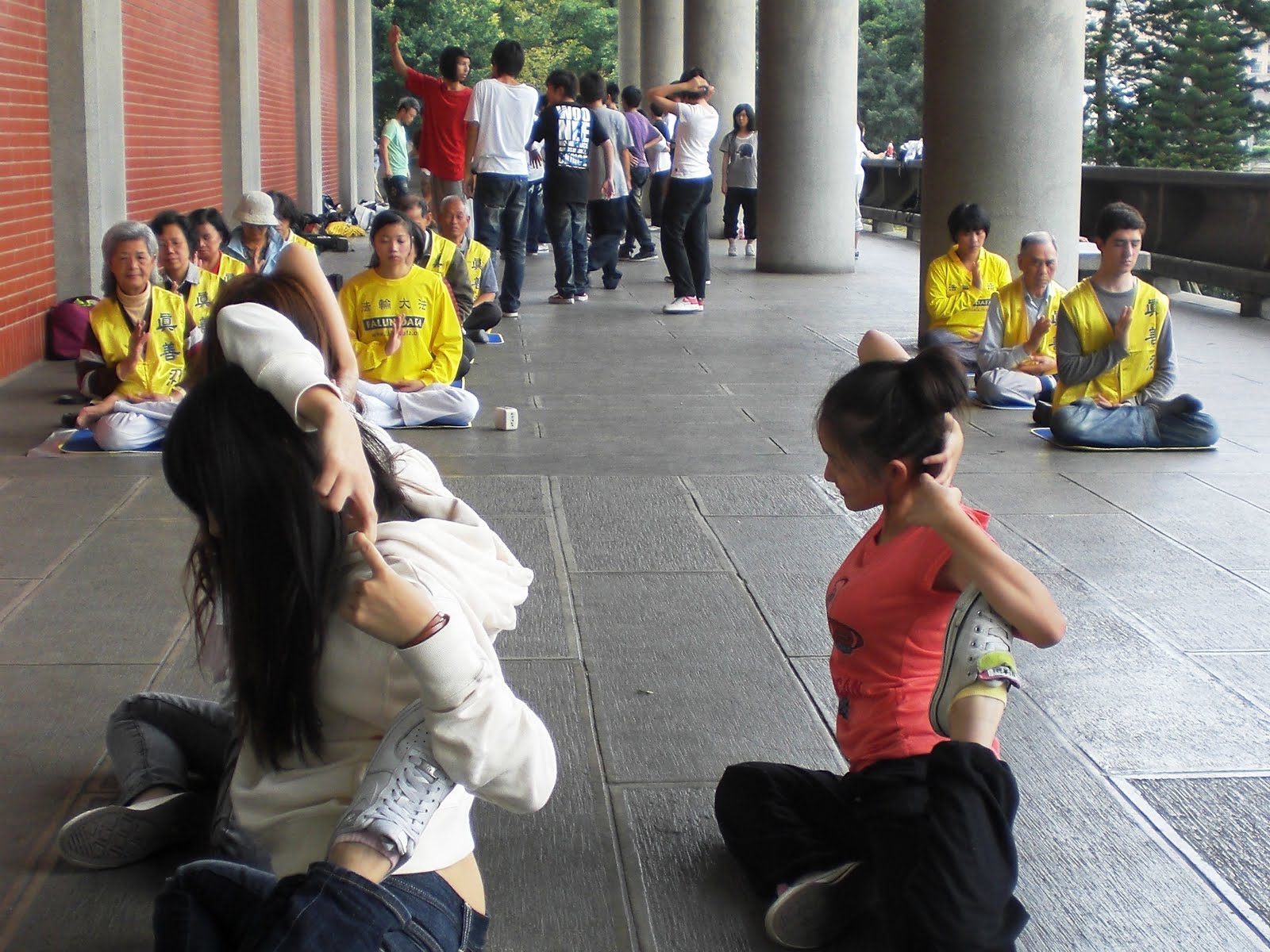
A few weeks ago I made a short stopover in Taipei, Taiwan on my way back to Thailand for a quick visit and to say hi to a couple I know who work on the island. Besides a few of the temples, public spaces and parks, the aesthetic of the city - crowded, with functional architecture and drab, if any, decor - is not too exciting. So on a Sunday when most people take a day off their hectic and packed East Asian schedules, the spaces around museums and parks make for some absorbing people-watching. It seems that everyone who can be out, is out. Around several of the places we visited, packs of teenagers practiced their dance moves and competed for space with the yellow shirt Falun Gong (or Dafa) followers meditating. The photo above shows teenage girls staking out there spot next to Falun Gong followers, who were making their cause known especially to Chinese mainlanders visiting tourist hotpots. Today, May 13, is the "World FalunDafa Day" set aside for the religious movement to commemorate the spreading of the message to the public. Below are a few more photos from the trip.
The Venerable Dhammananda is charismatic, warm, well-spoken and leaves a strong impression on those who've met her - and has the distinction of being the first Theravada bhikkhuni(female monk) in Thailand. A few weeks ago I went down to Nakhon Patom to spend time at her center at Wat Songdhammakalyani. As it was a slightly more stressful time than usual, this weekend retreat was perfect timing. I went with Brooke Schedneck, a friend from Harvard Divinity School days who is in Thailand doing field research for her dissertation (both of us pupils of our beloved Don Swearer). Brooke is interested in Ven. Dhammananda as a meditation teacher to foreigners. I am interested in Ven. Dhammananda's thoughts on on gender and inter-religious dialogue. I probably would not have made it a weekend-long venture, but Brooke has done so many meditation retreats she made it easier for me to deal with the simple monastic life of hard beds and waking up before dawn.
I first met and interviewed Ven. Dhammananda in 2007 at the International Conference on Religion and Culture in Chiang Mai where I presented a paper on Buddhist art and gender. In our first conversation we discussed gender in the writings of Dr. Chatsumarn Kabilsingh for several minutes before I (finally! gasp ...) realized Dhammananda was Dr. Kabilsingh before her monastic metamorphosis! Same person, different name. This slightly embarrassing episode served our discussion well. As we both noted, my momentary non-recognition reinforced a point we were making: ordination visually removes the easy markers of gender - a face without make-up, shaved hair, robes concealing sexed contours. Dr. Kabilsingh was for over 30 years a professor of philosophy and religion at Thammasat University, where she wrote the bulk of her many works on, among other things, Buddhist texts, commentary, and gender. But her commitment to monastic life can be seen anchored even further back than academia, to her extraordinary childhood as daughter of Ven. Voramai Kabilsingh, the first Thai bhikkhuni, ordained in the Taiwanese Mahayana line. Her life was saturated with chanting and meditation. Her mother converted their home into Wat Songdhammakalyani (literally, the temple of women who uphold the dhamma). As a young girl she says she could recite whole chants by rote memory "like a parrot." Life as an academic allowed her to explore the meaning of what she memorized as a child. She told us she waited until her youngest child passed 25 years of age before she followed her mother's footsteps and ordained. But going further than her groundbreaking mother, she sought a Theravada ordination through the newly revived bhikkhuni tradition in Sri Lanka. A proper Theravada ordination would give her a greater chance of recognition in the Thai Sangha (the official ruling hierarchy of Thai Buddhism), and would better situate her to pass on the bhikkhuni lineage at home.
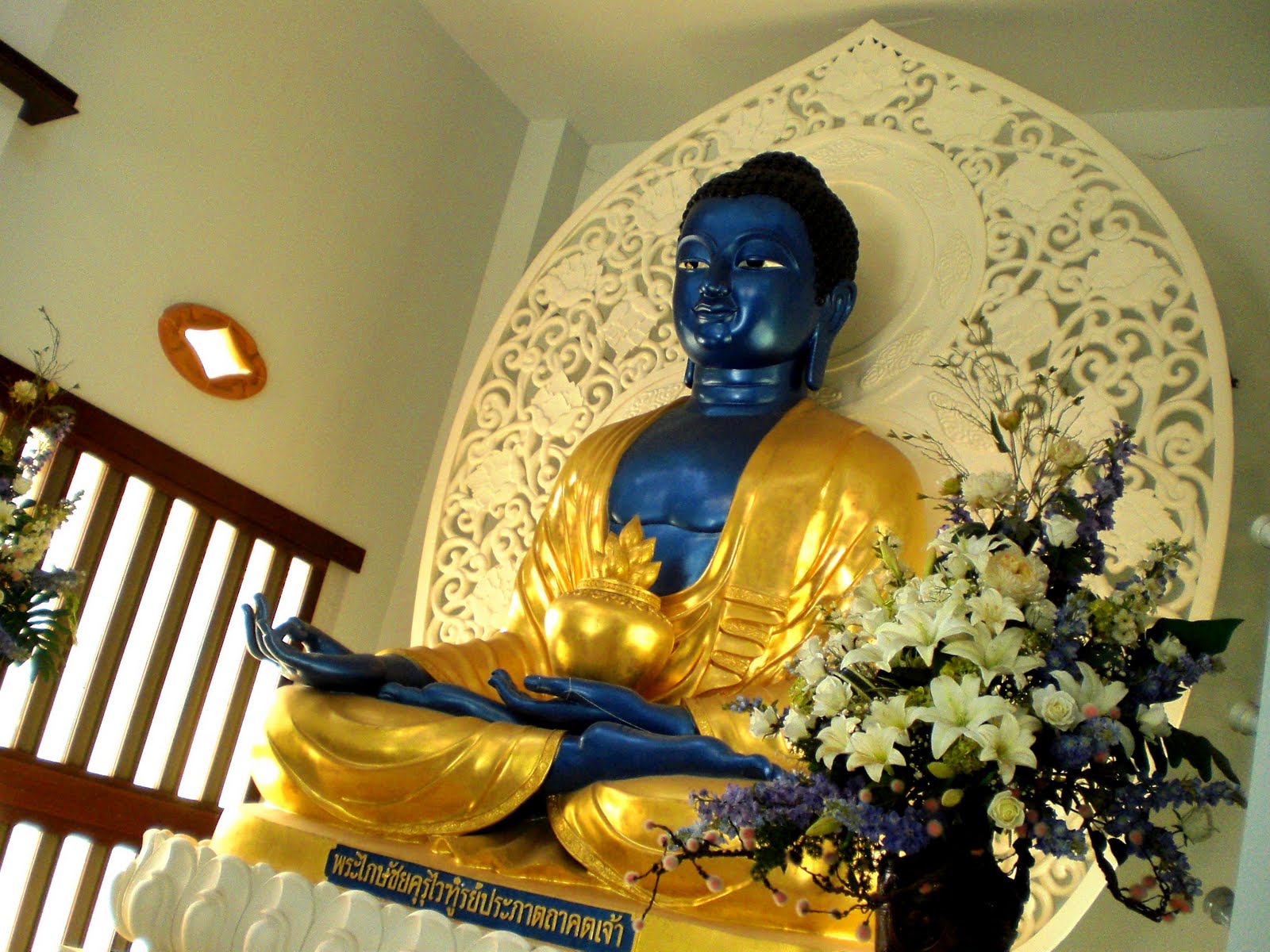
Brooke and I arrived and quickly got into the rhythm of the weekend events. We were plopped in the middle of a training session for the center's core volunteers. On the whole they were nice and helpful - presumably that is part of the training! as they prepared to take some of the workload off Ven. Dhammananda and the other samaneri (female novices). We skipped the sessions on temple rules, taking care of guests, and how to give tours of the grounds - I for one needed rest and was desperate for a shower (the first of three that day) after an overnight bus and the inferno-like heat of Nakhon Patom at noon in the height of hot season. One interesting session was on Visualization. Put in simple terms: how you 'visualize' an object or problem can determine your response and approach to it. A bit of experiential learning helped to demonstrate the point. Four of us were asked to visualize a volunteer sitting in a chair as a heavy stone. When it came time to lift the woman from the chair with our fingers, we couldn't make it happen. But when we closed ours eyes and visualized the woman as a feather, we lifted her up easily. It worked! The use of Visualization meditation and mental training exemplifies the many ways Ven. Dhammananda draws from Tibetan Buddhism. More importantly she draws from the Tibetan tradition her own understanding of the Medicine Buddha. Ven. Dhammananda has a local reputation as a healer and had a distinctive vision of the Medicine Buddha fleshed in blue (top photo).
We were encouraged to join the morning alms rounds. I wasn't sure what to expect, or if that many people would give food to female monks, but they are known and taken care of by the nearby villagers. They also know she is a strict vegetarian, thank goodness, because I didn't want to feel obliged to eat seafood or something worse at 7am. The samaneri giving the blessing is adorable (top-right), she loves to touch and talk to the alms-givers. Of course in good Thai-time some lay people rushed up on motorbikes moments before we entered the gates. That seems also routine. Bottled water, blessed by Ven. Dhammananda, with the blue Medicine Buddha logo (left), are distributed to alms-givers in need of healing.
We were joined later by a documentary film maker from The Buddhist Channel in France. The three of us went everywhere Dhammananda went, which was great. She received an invitation to the chanting / fund-raising event by the abbot of Wat Luang Por Sot, an unfinished but huge Dhammakaya temple nearby. The abbot supports Dhammananda and the revival of the bhikkhuni line in Thailand, but he is limited by the constraints placed on him by the Thai Sangha. He showed his support by inviting her to present gifts to the male monks at the ceremony. Of course it wouldn't be a Dhammakaya event without attracting the rich and famous, so there were a few Thai movie stars giving gifts as well! Ven. Dhammananda sits in a special place (left). We were behind her with the mae chii (nuns who dress in white, shave their hair and follow 8 precepts) and other female laity dressed in white, and we were escorted to the 'VIP' section for lunch.
Ven. Dhammananda interprets the Thai Sangha's refusal to recognize the new bhikkhuni lineage as mixed. The lack of legitimation by the national hierarchy leaves a great deal of room for intellectual freedom as a public figure and autonomy to make decisions without having to answer to the Thai leadership. Last year, 30 women joined in a 9 day temporary ordination. They expect at least 50 this year, while busy figuring out how to house them all and constructing a new building for future growth.
It is no wonder that Ven. Dhammananda has become an important Buddhist voice. Her belief in her gender equality, dialogue with Buddhist and other faith traditions, inviting presence, command of English, and reputation as a healer, attract seekers and scholars alike. It was a much needed retreat for me, and to paraphrase a popular saying from one of her books, a calming of my monkey mind.
I'm thankful for a lovely year once again for work, play and travel.
This season I will be spending the holidays staying close to Chiang Mai, quite busy with deadlines, yet still able to join in the many fun celebrations with friends, colleagues and students.
I will be missing my family quite a bit this Christmas. But people have really shared the Christmas giving spirit. I want to Thank Joan Eubank in particular for the cute little handmade wise-men from a Wa minority village. They look great around the tree.
Hello everyone, and welcome to The Red Connection, a blog on travel, culture, religion & spirituality. The Red Connection also gives visitors and friends a chance to see some of my interests and what I’m up to, ask questions or make comments. Enjoy! - Eva Pascal (a.k.a. aj.Daeng)








 Posts

